1
Re-Establish the Garden
Assess the site, remove debris, preserve healthy perennial herbs and flowers, define beds and pathways, improve the soil, repair garden borders, and prepare seasonal vegetable areas.
A community-centered plan for restoring and caring for a garden with perennial herbs, perennial flowers, pollinator plants, and seasonal vegetables.
This volunteer plan supports the re-establishment and seasonal care of a shared garden that grows food, strengthens community relationships, teaches practical gardening skills, and honors the natural rhythm of the year.
A cleaned-up visual map of the raised garden beds, with East oriented toward the top of the page, including perennial herbs, mint bushes with lilies, hostas, irises, short day lily, catnip, annual vegetable panels, and the white grape vine growing eastward along the south-facing fence.
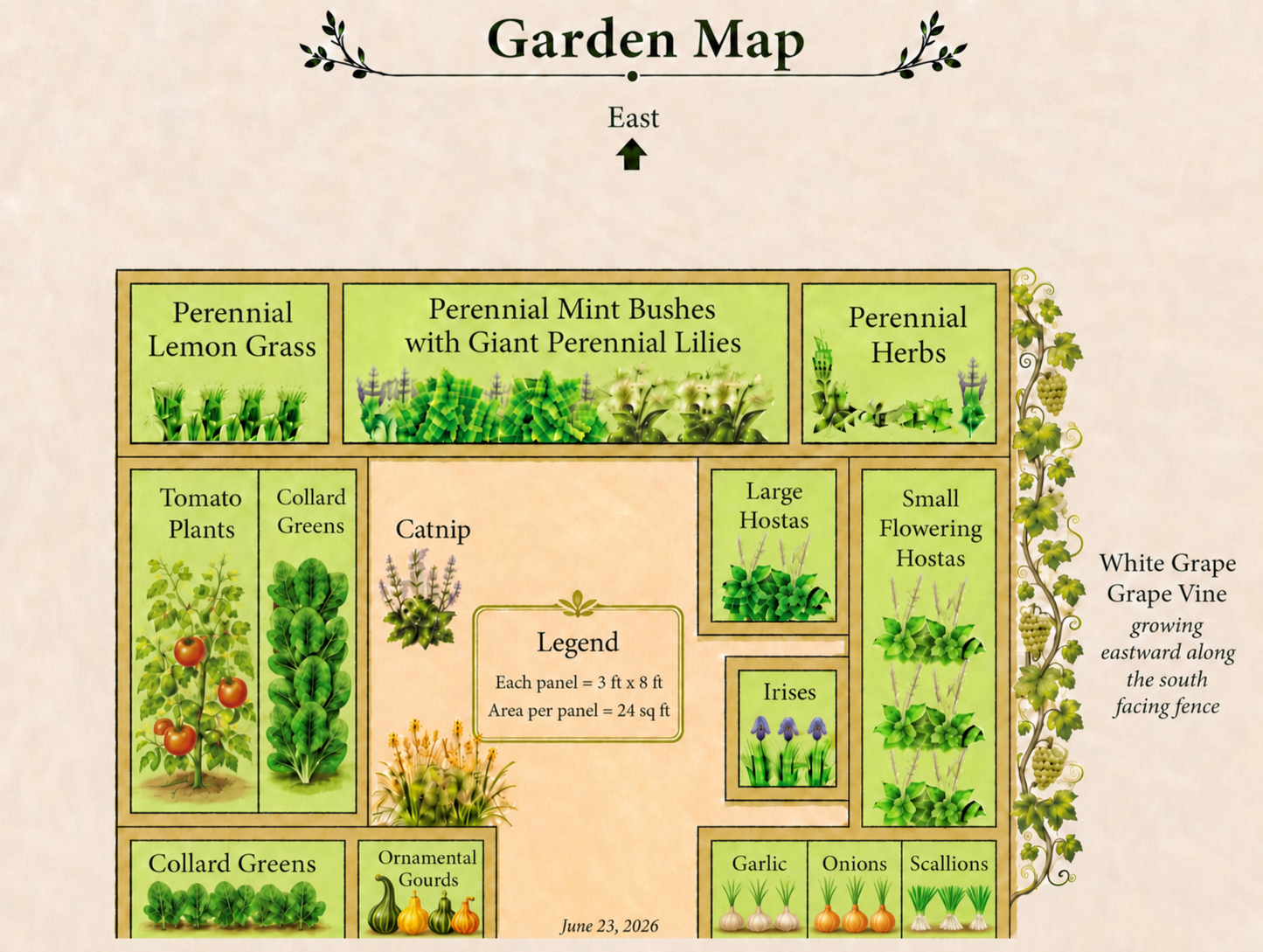
Use this map as the field guide for volunteer placement, planting assignments, weeding zones, watering zones, and news interview visuals.
The work is organized so volunteers know what to do at the beginning, middle, and end of the growing season.
Assess the site, remove debris, preserve healthy perennial herbs and flowers, define beds and pathways, improve the soil, repair garden borders, and prepare seasonal vegetable areas.
Organize weekly volunteer teams for watering, weeding, harvesting, composting, pest observation, plant support, labeling, mulch care, and community updates.
Remove finished seasonal plants, compost healthy material, mulch perennials, store tools, secure hoses, record lessons learned, and prepare the garden for next year.
Each team carries a clear responsibility so the garden remains organized and does not depend on one person.
Coordinates the schedule, supplies, planting plan, garden map, and communication.
Waters vegetables, new plantings, herbs, flowers, and dry beds as needed.
Maintains vegetable beds, perennial beds, borders, and walking paths.
Harvests ripe produce, records what was collected, and supports fair distribution.
Manages compostable material, removes waste, and keeps the garden safe and clean.
Creates signs, plant labels, youth activities, community updates, and learning moments.
This calendar provides a simple rhythm for restoring, maintaining, harvesting, and closing the garden.
| Season | Main Focus | Volunteer Tasks |
|---|---|---|
| Early Spring | Re-establish garden | Cleanup, mapping, soil preparation, compost, identifying perennials, repairing beds and paths. |
| Mid Spring | Plant cool-season crops | Plant lettuce, greens, peas, onions, herbs, and label garden beds. |
| Late Spring | Prepare summer beds | Mulch, weed, add supports, plant flowers, and prepare warm-season vegetable areas. |
| Summer | Maintain and harvest | Water, weed, stake, harvest, monitor pests, and distribute produce to the community. |
| Late Summer | Refresh and replant | Remove finished plants, replant fall crops, add mulch, and continue harvesting herbs and vegetables. |
| Fall | Seasonal conclusion | Final harvest, cleanup, composting, mulching perennials, tool storage, and winter preparation. |
| Winter | Planning | Review notes, recruit volunteers, update supplies, and prepare next year’s garden plan. |
The harvest will be handled with gratitude, fairness, and accountability.
Supplies are grouped for mulching, weeding, planting, watering, safety, and news interview coordination.
| Work Area | Supplies Needed | Suggested Quantity |
|---|---|---|
| Mulching | Natural mulch, cardboard or paper weed barrier, mulch forks, bow rakes, wheelbarrows, buckets or tubs | 30-45 mulch bags, 2-3 carts, 4-6 rakes, 6-8 buckets |
| Weeding | Garden gloves, hand weeders, trowels, kneeling pads, pruners, weed buckets, yard waste bags | 15 glove pairs, 8-10 hand tools, 6-8 kneeling pads, 8-10 buckets |
| Planting | Annual veggie starts or seeds, compost, raised-bed soil, plant labels, markers, stakes, twine, tomato cages, trellis support | 10-16 soil/compost bags, 25-50 labels, supports as needed |
| Watering | Garden hoses, hose splitter, spray nozzles, watering cans, buckets, optional soaker hose or drip line | 2-3 hoses, 2-3 nozzles, 4-6 watering cans, 4-6 buckets |
| Safety & Comfort | First aid kit, drinking water, sunscreen, bug spray, hand sanitizer, paper towels, trash bags, shade canopy | 1 station for volunteer check-in and break area |
| Media Day | Printed MoH Garden Map, volunteer sign-in sheet, name tags, photo/video release forms, talking-points sheet | 15-20 printed copies plus one display copy |
These estimates are for planning and board submission. Actual prices vary by store, sale, season, and local availability.
| Category | Approximate Budget |
|---|---|
| Mulch: 30-45 bags, 2 cu ft each | $90-$225 |
| Compost, manure, or raised-bed soil: 10-16 bags | $60-$160 |
| Annual veggie starts and seed packets | $75-$200 |
| Gloves for 15 people | $75-$150 |
| Hand trowels, weeders, and pruners | $175-$325 |
| Rakes, shovels, and mulch forks | $300-$550 |
| Buckets, yard bags, labels, and markers | $80-$150 |
| Hoses, nozzles, watering cans, and hose splitter | $125-$250 |
| Two wheelbarrows or garden carts | $180-$350 |
| First aid, water, sunscreen, bug spray, paper towels | $75-$150 |
| Media-day table, name tags, printed maps, release forms | $40-$100 |
This landing page summarizes the volunteer plan for re-establishing, maintaining, harvesting, and seasonally concluding the Mothers of Hope Community Garden.